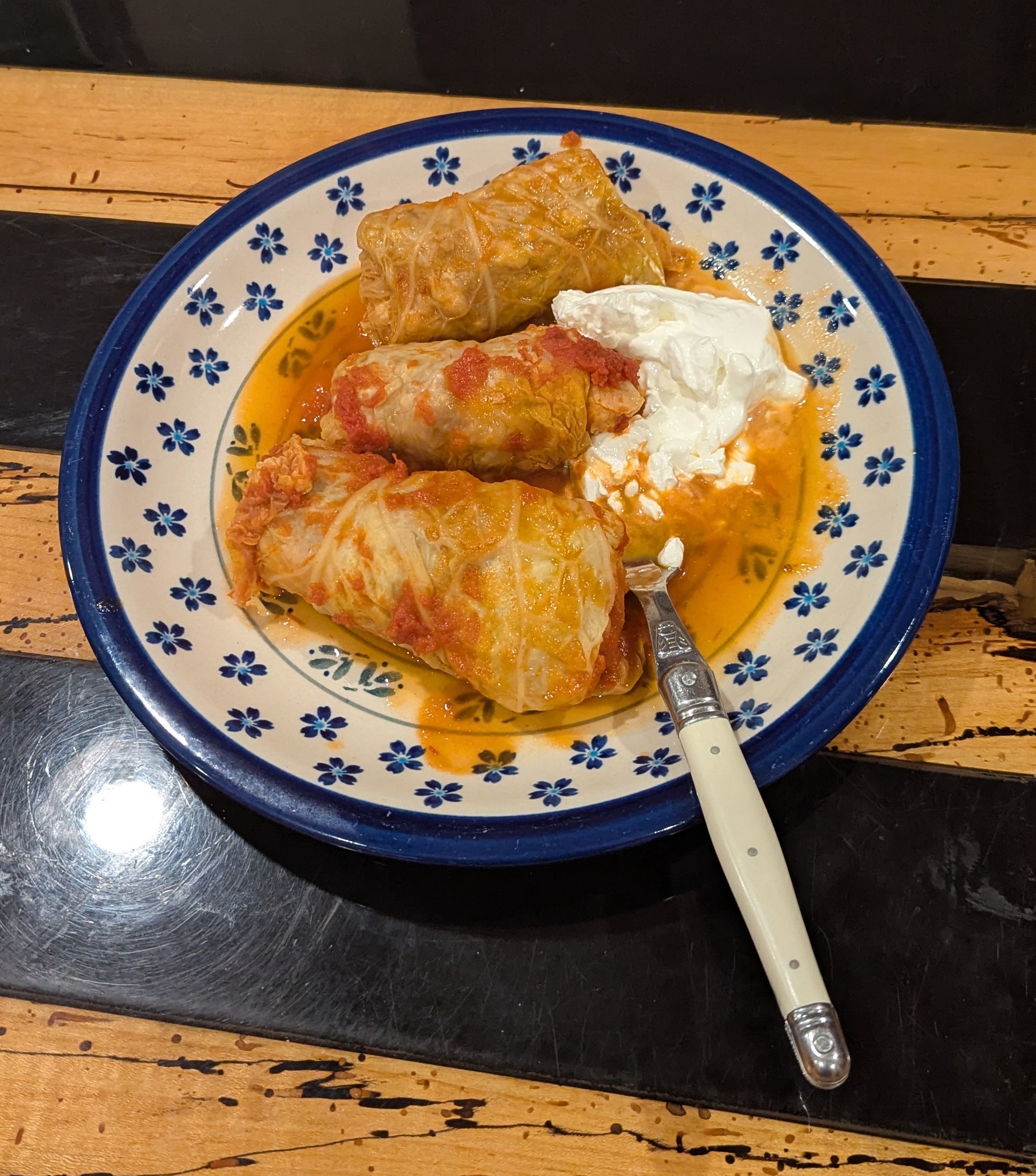
No matter the spelling, it is definitely stuffed cabbage.
This is another endeavor to record food recipes that originated from Grandmom Zdepski’s kitchen. This one came to my attention as handwritten by Ruth M. Zdepski, circa 1980, and preserved by my wife Linda Zdepski with her recipe compilation, transcribed by me. (Gullumghy is Ruth’s spelling.)
1 lb. ground beef
1 large onion
2 stalks celery
2 cups rice
In large pan, put head of cabbage with water and boil so leaves cut off easily.
Boil rice, but not done.
Beef, onion and celery in a skillet and fry. Render fat and put in a large bowl with rice and mix.
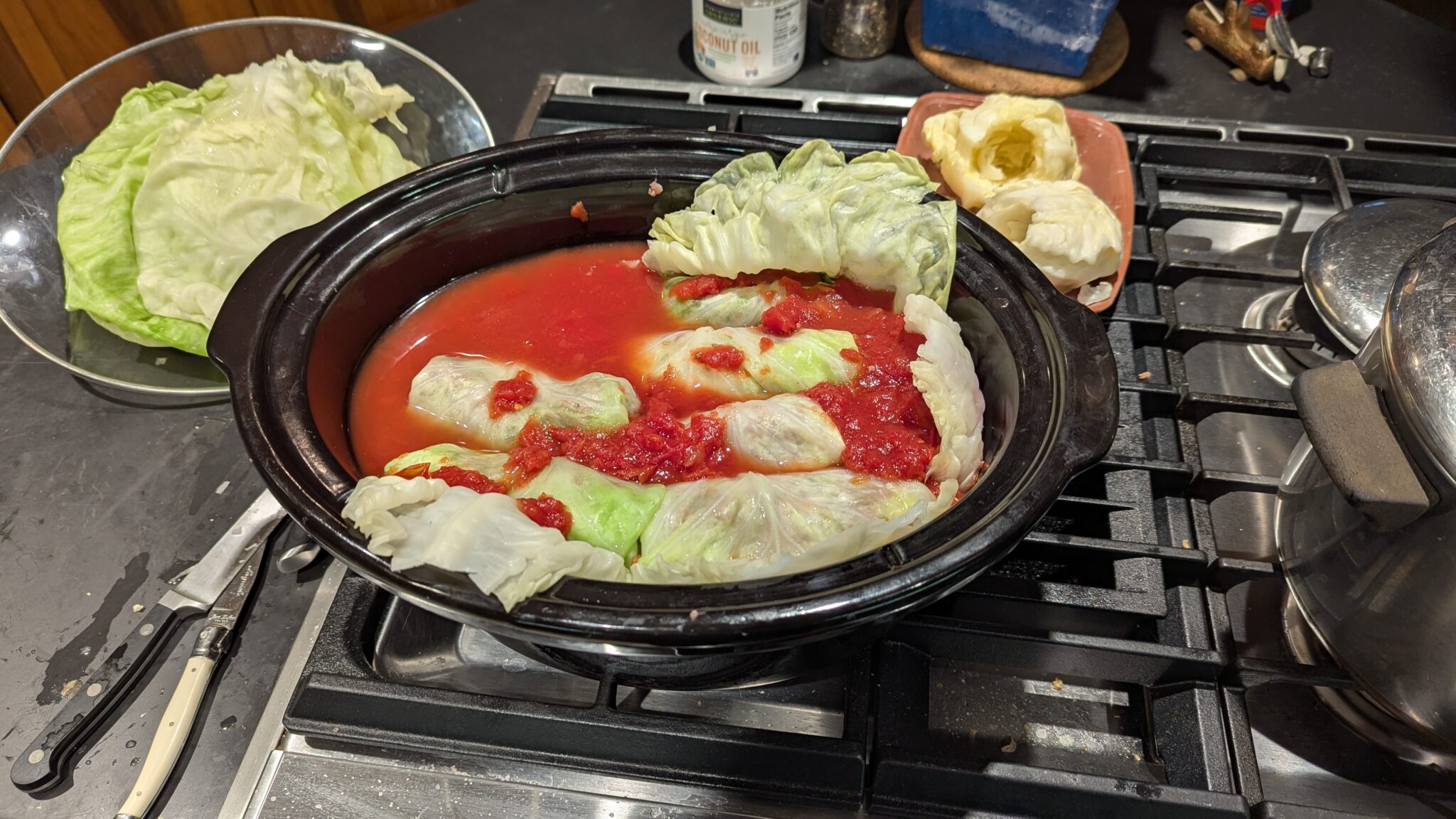
Cut cabbage leaves whole. Put rice and meat mixture in a large bowl and put ½ cup of the mixture in cabbage. Place in roasting pan side by side. Add 1 cup of water and bake ½ hour in 350o F oven until done.
What follows are comments and research results by me.
The recipe above is most likely Grandmom Zdepski’s simplest way of making golumpki. Ruth was obviously in a hurry when she wrote this recipe, as she omitted steps, such as chopping the onion and celery. I’m not sure if the idea of coring the cabbage was part of kitchen life, but she doesn’t mention that, either. She also omits the folding process of rolling the cabbage leaves around the stuffing. There is no mention of cutting the thickest veins at the base of the cabbage leaves, either.
As a child, I distinctly remember Ruth placing a Ball jar of home-canned stewed tomatoes over the top of the golumpki after the pan was filled and before it was covered. I also recall being allowed to remove the cabbage wrapping and eat just the filling; this tasted like “porcupine balls,” a meat and rice mixture served in the school cafeteria. The cooked cabbage had a strong odor and taste for young children. I remember getting the gag reflex from it, much to our father’s disgust.
A memorable golumpki meal, made just once by our father Stephen, was cabbage leaves stuffed with buckwheat groats. He must have miscalculated the amount of liquid necessary to hydrate the buckwheat as the result was very dry, and I don’t think there was any meat in it. It was like eating boiled cabbage-flavored sand, and it definitely made me gag. None of the four oldest children would eat more than a bite or two, which offended our father. Unfortunately, he’d make a large pot of this concoction, and he had invested his ego into this meal; therefore, we were forced to sit around the table until our plates were empty. It got pretty lonely in the kitchen, and Dad would come and check on our progress periodically. I think Ellen and I were the longest holdouts.
Both Uncle John and Dad made golumpki with buckwheat groats in their adult life, which after 50-plus years, it occurred to me that their mother must have made the dish frequently, and it must have tasted good to them. Unfortunately, I’d waited until all representatives of that generation had passed before I began to think about it. My daughter Anna returned from a wedding in Romania and confessed to Linda that she’d had golumpki at the reception that tasted the best ever, even better than her homemade ones. The secret ingredient in these morsels turned out to be pork belly.
In retirement I began looking at golumpki recipes using both Google and YouTube and figured I’d find out about buckwheat groats and how to make them edible. First off, I learned that like borscht, there are a host of golumpki recipes, and it will take a while to sample the spectrum. Google AI provided a recipe for pork belly and buckwheat golumpki. It was my line of reasoning that perhaps pork belly could have been used by Grandmom when making buckwheat golumpki in the 1930s.
In a discussion with my daughter Anna about the golumpki experiments, she suggested that I reach out to my older cousins for their memories. This turned out to be a great idea, and my simple act of writing down a recipe turned into a journey through the family archives of a much broader group than just my household.
Cousin Michael Stephen offered the following:
“Golumpki is of course firmly within my memory from our grandmother’s plate of many dozen from the wood stove. My mom also made them, but of course the southern Italian version, which was a tomato sauce rather than the more orange sweet sauce, Polish version.
My mom’s was not with rice, and I only remember rice from our grandmother’s, but I might be confusing the two.
I know the golumpki from Veselka in New York are different, as well. So I wonder what is Polish verses Ukrainian or possibly Jewish. I know the Italian version was ground beef, something with a little sausage. I wonder if the Polish/Ukrainian versions were pork?
As I remember, our grandmother’s was smaller in size.”
Here is Cousin Wanda’s remarks on Uncle John’s buckwheat groats version:
“As I remember from watching, he cooked a box of the groats according to box instructions. He sautéed chopped onions, and I’m assuming a pound (or maybe two, because he made a turkey roaster full) of hamburger, then cooked the beef with the onions till done, then mixed in the groats.
He had previously stuck a head of cabbage in a pot of boiling water to loosen the leaves. He cut some of the leaf rib away so the leaf would be more pliable to roll around the filling.
When he got them all rolled and in the roaster, he’d splash vinegar over the top and cover them with the large outer leaves so the top ones wouldn’t burn. I loved the vinegary ones! My guess is they baked at 350 degrees till heated through, maybe 45-60 minutes, and he salt and peppered the meat.”
______________________________________________________________________
Aunt Anna’s Golumpki:
Linda and I lived at Aunt Anna’s from September through October 15, 1985, and Linda saw her make golumpki in a crock pot. She used the basic meat and rice stuffing described above.
Before covering the stuffed rolled cabbage, she added crushed tomatoes and then used part of a container of sauerkraut sprinkled over the top. Only then did she cover the top with excess cabbage leaves and start the crock pot.
______________________________________________________________________
Aunt Helen’s Golumpki, times two!
Cousin Diane (Fackleman) DeMott offered her recipes that were initially based on observing Helen making this staple dish. She doesn’t use a written recipe.
“All we do is mix hamburger, and you can add pork to that, also, with lots of sauteed onion and chopped-up bacon. Make some rice. Make sure it cools some before you mix it in with your hands. Otherwise, it hurts! I add salt and pepper and Worcestershire sauce, about a couple tablespoons.
I really don’t have a recipe with measurements. I just have always winged it .
As far as the sauce goes, I’ve made my own, and then again, sometimes I used jarred sauce.”
___________________________________________________________
On the advice of my daughter Anna, I also reached out to Darlene Fackleman for her take on Helen’s golumpki and found she had written down a recipe while following her mother around the kitchen.
Stuffed Cabbage
1 ½ cup dry white rice
6 pounds ground meat (mixture of beef and pork)
1 pound bacon, sliced both ways
5-6 medium onions, chopped
2 large heads of cabbage.
Cook rice. In frying pan, cook bacon and onion.
Do NOT pre-cook meat.
Add salt and pepper to meat mixture. Mix in some garlic.
Add strained bacon and onion to the meat. Add cooked rice. Mix and season to taste.
Boil a large soup pot of water. Core 2 (or 3) heads of cabbage. Drop them in the water whole, push down and cover to steam. When the outer layer of leaves “boil off,” lay them on the bottom of a large roasting pan (Pyrex is okay). Peel off the leaves as you go along, taking a leaf and cutting off the tough “stem.”
Fill with a few tablespoons of mixture at the stem end. Roll, always folding over the sides as you go along. Fill the baking dish.
To a 28-oz. can of crushed tomatoes, add 2 cans of paste and 2 cans of sauce. Or use fresh chopped tomatoes. Mom always put a bit of sugar in her sauce to cut the acid.
Pour on top of the cabbages to bake. Bake at 350 for 1 ½ to 2 hours.
[This recipe is approximately double the volume of the others, so invite family, or be prepared to freeze a few when you get done eating your meal.]
Cousin Darlene Ubry provided me with how she makes golumpki:
“I don’t have a recipe, but how I make them is instead of boiling the cabbage, I core it and fill it with water and freeze it. (A Polish lady from Manville told me to do that, and it works great.)
Then the day before using it, thaw it out, and each leaf comes right off, and you lose none of them. Then I stuffed them with hamburger and rice, and I use a crockpot and spaghetti sauce and cook on low, and it’s ready for dinner. I used to start it around 7:30am. I do have to say, I definitely didn’t get my mom’s ability to cook, but they are darn good.”
Cousin Walter John said his family didn’t have a golumpki recipe.
Cousin Donna Ripley also responded that her family did not make golumpki.
Attempts at Rehabilitating Buckwheat as a Foodstuff in my Household
My second go at using buckwheat was a partial success. This time I used regular green cabbage, 1 lb. ground beef, 1 lb. ground pork, and 1 cup of buckwheat cooked according to directions, with 1 tablespoon salt, 1 teaspoon pepper and 2 tablespoons of dill weed for the stuffing, but it still seemed to be missing something.
The third go is a mushroom-buckwheat meatless variety that I found from a Polish person’s YouTube video. This is a mushroom, onion, buckwheat variety. It was composed of ½ cup buckwheat, 2 tablespoons summer savory, 1 tablespoon salt, ¾ teaspoons black pepper, one chopped onion and two chopped cloves of garlic fried in butter, 24 oz. mushrooms sliced and cooked in a frying pan. Quite frankly, this one was a bit bland. It will take some more experimentation to land on an acceptable meatless recipe.
The fourth go at rehabilitating buckwheat resulted in an unqualified “perfect” from Linda, my second harshest critic. It is therefore worthy of sharing.
Filling
1 cup buckwheat cooked according to directions
1 lb. smoked kielbasa cut into small cubes
7.5 oz. pork belly cut into small pieces (while partially frozen)
2 Tbs. dill weed
1 Tbs. salt
¾ tsp. ground black pepper
1 large onion and 2 cloves garlic chopped fine and fried in bacon grease
10 oz. mushrooms sliced and cooked in frying pan
Once the cabbage rolls are formed and packed into the crockpot, add 28 oz. petite diced or crushed tomatoes and 1 pint of chicken broth over the rolls. Sprinkle on a couple of ounces of sauerkraut, and cover with cabbage leaves. Cook on high for about 1.5 hours.
Conclusion
So there you have it. There are as many ways to making golumpki as there are people in the family making them. Even two sisters watching the same mother making them came up with two slightly different recipes. My journey through Google and YouTube looking for information confirms there is a wide variation, and I’m going to experiment further. My goal of placing buckwheat into my family diet was achieved.
Oh, the spelling in the title are Ukrainian (I think), Polish, Russian, and phonetic. The Russian name translates as ”little pigeons.” I don’t know about the other languages.
During the 1970’s Linda had copied pages from an obscure cookbook named ”Too Russian to be Ignored”. The Golubtsy recipe covers pages 208 to 213, it is very detailed in words and illustrations. This reciepe is the source of the ”little pigeons” translation of the name. Interestingly, this is the only reciepe I’ve seen where the cabbage rolls are placed vertically into the pot for final cooking; the Russians have their own way of doing things. This reciepe also has a gravy or roux being made in the final stages of the baking process. It is a complicated one!


Leave a Reply